If you’ve ever stood under a car, staring up at those L-shaped metal arms connecting the wheel hub to the chassis, you’ve probably glanced at the little rubber (or sometimes polyurethane) donuts sitting right in their centers—control arm bushings. As someone who’s spent the last 8 years working at a control arm parts supplier, I can’t tell you how many times I’ve heard customers, even seasoned mechanics, ask, “What’s the point of those? They just look like cheap rubber. Why not skip ’em and bolt the arm straight to the frame?” Let’s break this down like we would over a coffee during a busy work week, no stuffy engineering jargon that makes your eyes cross. Control Arm

First, let’s get one thing straight: control arms (A-arms, upper/lower arms, whatever you call them) do most of the heavy lifting for your car’s wheel alignment. They hold the wheel in the exact right spot up, down, forward, and back as you drive over bumps, turn, or even just pull away from a stop sign. If you bolted the arm straight to the chassis, no bushing, that metal-on-metal connection would transfer every tiny, violent jolt straight into your hands, your steering wheel, and even your spine. Hit a pothole at 30 mph? You’d feel it all the way up your arms, and your car would lurch so bad you could barely keep it straight. That’s where the bushing comes in—it’s the car’s filter for all that road noise, vibration, and harshness (we call it NVH in the shop, short and easy).
Wait, it’s not just about comfort, though. That’s the big one people notice first, but bushings do way more work behind the scenes. Let’s think about alignment. Every time you drive over a bump, the wheel naturally wants to shift forward or backward, right? If there’s no bushing, that shift is rigid—your toe (the angle of the wheel relative to the car’s centerline) would go all out of whack every time you hit a tiny imperfection. That makes your tires wear out super fast, like, 10k miles instead of 50k kind of fast. A good bushing lets the control arm flex just enough to absorb that bump movement, but keeps the wheel aligned where it needs to be. No more premature tire blowouts or needing an alignment every single month.
Let’s talk about cornering, too. When you turn, your car’s body rolls to the side, right? That lean shifts the control arm’s angle, and without a bushing, the wheel would pivot too much, throwing off your camber (the angle of the wheel from front to back, or side to side, depending on the setup). A properly spec’d bushing is rigid enough when you push hard, like during a fast on-ramp merge, so the wheel stays planted against the road, but soft enough to soak up the small stuff. It’s a balance, and that’s why not all bushings are the same—some are stiffer for sports cars, some are softer for pickup trucks that carry heavy loads, and some are even hybrid designs for sedans that want a little of both.
I’ve seen this play out firsthand with a customer a few months back: a guy with a 2018 F-150 that he used for both work hauling lumber and weekend off-roading. He came in complaining of a steering wheel that shook at highway speeds and tires that wore smooth on the inside edge after only 15k miles. We popped the front control arms off, and sure enough, the original rubber bushings had started to crack and compress from the constant load of hauling and rough trail driving. Once we replaced them with our heavy-duty urethane bushings (we test every batch on our in-house load rigs to make sure they hold up to 10k lbs of force without warping), he called a week later saying the shake was gone, his alignment stayed on, and his new tires were already wearing evenly. That’s the real purpose, right? Solving a problem that the average driver doesn’t even know they have until it’s too late.
Another myth we hear all the time: “polyurethane bushings are better than rubber, full stop.” Not exactly. Rubber bushings are designed to have a little give in all directions—they absorb side-to-side movement, front-to-back movement, and up-and-down movement all at once. That’s why older cars with original rubber bushings feel so smooth on the highway, even over rough pavement. Polyurethane is stiffer, so it’s better for performance applications where you want zero flex during hard driving, but it’s way noisier over small bumps and will wear out faster if you’re not used to that stiff ride. Our team designs each bushing to match the vehicle’s intended use—we don’t just sell stiff stuff because it’s trendy. That’s what a control arm supplier should do, right? Not push parts that don’t fit the job.
Let’s also touch on safety, because that’s the part nobody talks about enough. When a bushing wears out, it doesn’t just make your car ride rough. It makes your steering feel “loose”—like when you turn the wheel, it takes an extra inch or two before anything happens. That’s dangerous in an emergency, like if a kid runs into the street and you have to swerve fast. A worn bushing can cause the control arm to shift unexpectedly, leading to a loss of control, or even a wheel misalignment bad enough to cause a blowout at high speed. I’ve seen the aftermath of that, and it’s not pretty. So those little donuts under the car aren’t just a comfort part—they’re a safety part too.
Wait, can we circle back to that original question? “What’s the purpose of control arm bushings?” It’s three main things, in my book: first, they isolate the cabin from road noise and vibration, making every drive smoother. Second, they maintain proper wheel alignment and control arm movement, so your tires last as long as they should and your car handles correctly. Third, they keep you safe by preventing unwanted wheel shifts and maintaining steering response. That’s not rocket science, but it’s also not trivial—every part on a car works together, and if one small part fails, it breaks the whole system.
As a control arm supplier, we test every bushing we make under real-world conditions, not just in a lab. We run them for thousands of cycles on our test rigs, simulate extreme heat and cold (from Arizona summers to Minnesota winters), and even test them under heavy loads to make sure they don’t crack or compress. We know that when our parts go into a customer’s car, they’re not just selling parts—they’re keeping people safe, saving them money on tires and alignments, and making their daily drives less of a headache. If you’ve noticed that your car is riding rougher than it used to, your tires are wearing unevenly, or your steering feels loose, it might be time to check your control arm bushings. Don’t wait until they completely fail—by then it’s way more expensive to fix.
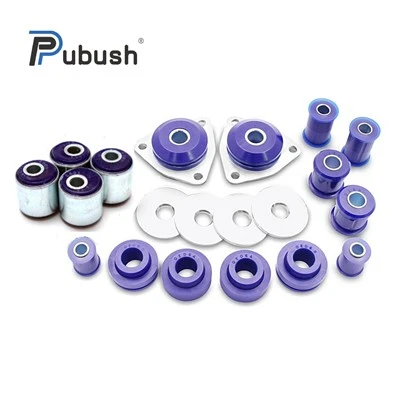
If you’re a mechanic, a parts buyer, or someone who just wants to keep their car running right, reach out to us. We can help you pick the right bushings for your vehicle, whether it’s a daily driver, a work truck, or a performance car. We don’t do one-size-fits-all here, because we know every car’s needs are different. We stand behind every part we sell, because we’ve spent years perfecting our process and testing our products to make sure they work when you need them most.
Shock Absorber References:
- Society of Automotive Engineers (SAE) International. (2021). NVH Control in Passenger Vehicles: Isolation Technology for Suspension Components. Warrendale, PA: SAE International.
- Automotive Aftermarket Suppliers Association (AASA). (2022). Suspension Component Wear and Replacement Guidelines for Light-Duty Vehicles. McLean, VA: AASA.
- Rubber Manufacturers Association (RMA). (2020). Automotive Rubber Components: Material Selection and Performance Testing. Washington, D.C.: RMA.
- Polyurethane Development Association (PDA). (2021). Polyurethane Suspension Bushing Applications in Performance and Heavy-Duty Vehicles. Cleveland, OH: PDA.
Xingtai Refined Machinery and Auto Accessory Co., Ltd.
Xingtai Refined Machinery and Auto Accessory Co., Ltd. is one of the most professional control arm manufacturers and suppliers in China, featured by quality products and low price. Please rest assured to wholesale durable control arm made in China here from our factory. Customized orders are welcome.
Address: XINGTAI REFINED MACHINERY AND AUTO ACCESSORY CO., LTD507 NORTH TAIHANG ROAD, XINGTAI CITY, HEBEI PROVINCE, PR.
E-mail: lindy@rfauto.biz
WebSite: https://www.pubush-suspension.com/
