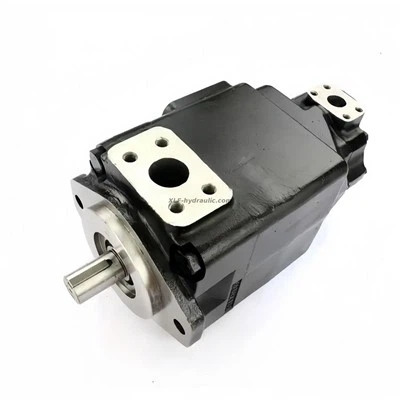
As a supplier of axial piston pumps, I’ve witnessed firsthand the critical role that speed plays in the performance of these essential hydraulic components. Axial piston pumps are widely used in various industrial applications, including construction machinery, agricultural equipment, and aerospace systems, due to their high efficiency, reliability, and ability to handle high pressures. In this blog post, I’ll delve into how the speed of an axial piston pump affects its performance and why it’s crucial for customers to understand these dynamics when selecting a pump for their specific needs. Axial Piston Pump
Flow Rate
One of the most significant factors influenced by the speed of an axial piston pump is the flow rate. The flow rate of a pump is the volume of fluid it can deliver per unit of time, typically measured in liters per minute (L/min) or gallons per minute (GPM). In an axial piston pump, the flow rate is directly proportional to the speed of the pump shaft. This means that as the speed increases, the flow rate also increases, assuming all other factors remain constant.
The relationship between speed and flow rate can be explained by the basic operating principle of an axial piston pump. In these pumps, the pistons are arranged in a circular pattern around a central shaft. As the shaft rotates, the pistons move back and forth within their cylinders, creating a pumping action. The faster the shaft rotates, the more times the pistons move in and out of their cylinders per unit of time, resulting in a higher volume of fluid being displaced and, consequently, a higher flow rate.
However, it’s important to note that there are limits to how much the flow rate can be increased by increasing the speed. At very high speeds, the pump may experience cavitation, which is the formation and collapse of vapor bubbles in the fluid. Cavitation can cause damage to the pump components, reduce the pump’s efficiency, and lead to premature failure. Therefore, it’s essential to operate the pump within its recommended speed range to avoid these issues.
Pressure Generation
The speed of an axial piston pump also affects its ability to generate pressure. Pressure is the force exerted by the fluid per unit area and is typically measured in pascals (Pa), bars, or pounds per square inch (psi). In an axial piston pump, the pressure is generated by the displacement of the pistons within their cylinders. As the pistons move, they push the fluid out of the cylinders and into the system, creating pressure.
The pressure generated by an axial piston pump is influenced by several factors, including the design of the pump, the size of the pistons, and the amount of force applied to the pistons. The speed of the pump also plays a role in pressure generation. At higher speeds, the pistons move more quickly, which can result in a higher rate of fluid displacement and, potentially, a higher pressure. However, this relationship is not always linear, and other factors such as the viscosity of the fluid and the resistance in the system can also affect the pressure.
In some cases, increasing the speed of the pump may not result in a significant increase in pressure. This is because the system may have a maximum pressure limit, beyond which the excess pressure is relieved through a pressure relief valve. Additionally, increasing the speed of the pump beyond its design limits can cause the pump to overheat, which can reduce its efficiency and lead to premature failure. Therefore, it’s important to select a pump with the appropriate pressure rating for the application and to operate it within its recommended speed range.
Efficiency
Efficiency is a measure of how effectively a pump converts mechanical energy into hydraulic energy. In an axial piston pump, efficiency is affected by several factors, including the speed of the pump. Generally, axial piston pumps are most efficient at their design speed. At this speed, the pump operates with minimal internal leakage, friction, and cavitation, resulting in maximum hydraulic output for a given input of mechanical energy.
When the speed of the pump is increased or decreased from the design speed, the efficiency of the pump may decrease. At lower speeds, the pumping action may not be as effective, resulting in lower flow rates and pressures. This can lead to increased internal leakage and friction, which reduces the overall efficiency of the pump. At higher speeds, the pump may experience cavitation, which can cause damage to the pump components and reduce the efficiency of the pumping process.
To ensure maximum efficiency, it’s important to select a pump with a design speed that matches the requirements of the application. Additionally, it’s important to maintain the pump properly and operate it within its recommended speed range. Regular maintenance, such as changing the oil, cleaning the filters, and inspecting the pump components, can help to ensure that the pump operates at peak efficiency and has a long service life.
Noise and Vibration
The speed of an axial piston pump can also affect the level of noise and vibration produced by the pump. Noise and vibration are generally undesirable in industrial applications, as they can cause discomfort to operators, damage to equipment, and interference with other processes. In an axial piston pump, noise and vibration are primarily caused by the mechanical forces generated during the pumping action.
At higher speeds, the pistons move more quickly, which can result in increased mechanical forces and, consequently, more noise and vibration. Additionally, the increased speed can cause the pump to operate closer to its resonant frequency, which can amplify the noise and vibration. To reduce noise and vibration, it’s important to select a pump with a low noise level and to install it properly. This may include using vibration isolators, mounting the pump on a solid foundation, and ensuring that the pump is properly aligned.
Wear and Tear
Finally, the speed of an axial piston pump can affect the wear and tear on the pump components. The moving parts of the pump, such as the pistons, cylinders, and bearings, are subject to friction and wear during operation. The higher the speed of the pump, the greater the forces acting on these components, which can result in increased wear and tear.
Over time, excessive wear and tear can cause the pump components to fail, leading to costly downtime and repairs. To minimize wear and tear, it’s important to select a pump with high-quality components and to operate it within its recommended speed range. Additionally, regular maintenance, such as changing the oil, cleaning the filters, and inspecting the pump components, can help to detect and address any signs of wear and tear before they become major problems.
In conclusion, the speed of an axial piston pump has a significant impact on its performance, including flow rate, pressure generation, efficiency, noise and vibration, and wear and tear. As a supplier of axial piston pumps, it’s our responsibility to understand these dynamics and to provide our customers with the information and support they need to select the right pump for their specific needs. By operating the pump within its recommended speed range, maintaining it properly, and monitoring its performance, customers can ensure that their axial piston pumps operate efficiently, reliably, and with a long service life.
Monoblock Control Valves If you’re in the market for an axial piston pump or have any questions about how speed affects pump performance, I encourage you to reach out to our team of experts. We’re here to help you select the right pump for your application and to provide you with the support and service you need to keep your equipment running smoothly. Contact us today to start the conversation!
References
- Stepanoff, A. J. (1957). Centrifugal and Axial Flow Pumps: Theory, Design, and Application. Wiley.
- Gulich, J. F. (2010). Centrifugal Pumps. Springer.
- In, W. K., & Jeong, Y. H. (2012). Effect of Operating Conditions on the Performance and Cavitation of an Axial Piston Pump. Journal of Mechanical Science and Technology, 26(6), 1771 – 1778.
- Karthik, K., & Senthilvelan, C. (2018). Performance Characterization of an Axial Piston Pump. International Journal of Engineering Research & Technology, 7(3), 147 – 151.
Wuhan Xinlaifu Hydraulic Equipment Co., Ltd.
Wuhan Xinlaifu Hydraulic Equipment Co., Ltd. is one of the most professional axial piston pump manufacturers and suppliers in China, featured by high quality OEM&ODM products. Please feel free to buy customized axial piston pump from our factory.
Address: Liansu Industrial Park, No.1, Xincheng 11th Road, Dongxihu District, Wuhan, Hubei, China
E-mail: service@xlf-hydraulic.com
WebSite: https://www.xlf-hydraulic.com/
